The UK offers a stunning, diverse range of urban and rural landscapes to enjoy from behind your handlebars.
But some regions might feel safer to travel through than others by a country mile.
So, we surveyed over 1,000 motorists (500+ being two-wheeler riders) and found that, while three-quarters (79%) feel safe on the roads, some factors jeopardise this – from road rage to night driving.
To help the riding community, we ranked 50 UK cities and towns for safety based on the below factors:
- Local crime rate – after 1 in 4 (27%) riders expressed concern in travelling through (what they consider) ‘areas with a negative reputation’
- Light pollution levels which could impact visibility
- Congestion – 27% say congested areas make them feel unsafe
- No. and proximity of police stations
It’s worth noting this is a snapshot based on available sources, so it’s not definitive.
UK’S SAFEST CITIES*
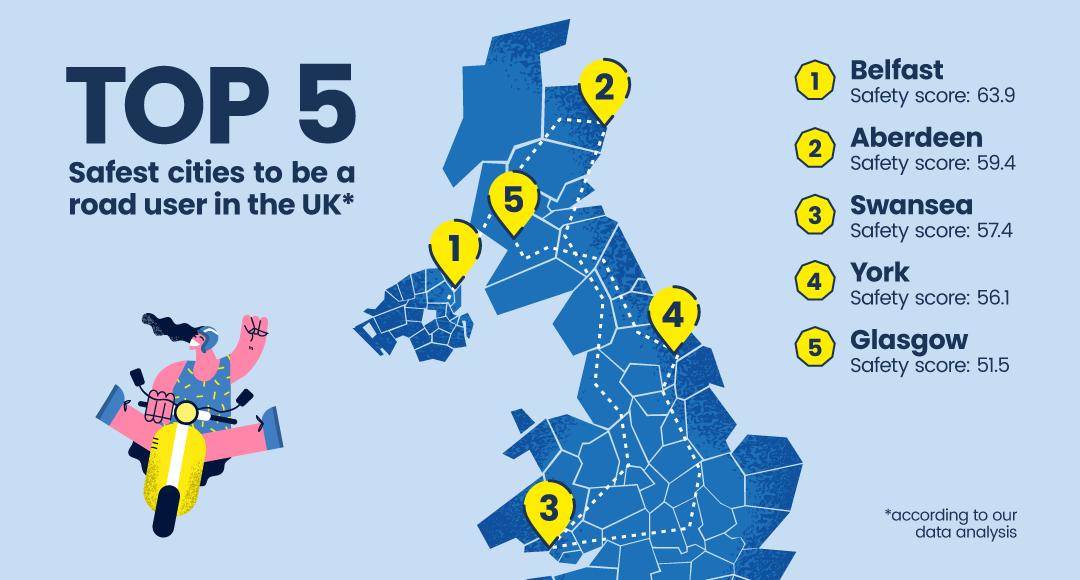
Celtic cities lead – Belfast in Northern Ireland is the safest to drive and ride in, according to our data.
Three Scottish cities make the top 6 – in fact, Aberdeen has the lowest crime rate of all the UK regions. Swansea comes in third for Wales.
York is the safest in England. London just missed this shortlist – in at 26th – but it does have the most police stations, followed by Manchester.
Portsmouth is the least congested. Traffic flows at 26mph, on average (the slowest being London, crawling at 8mph typically!).
Coastal haven Brighton & Hove, followed by Bournemouth, are the least light-polluted but fall in other respects. That’s positive because light pollution risks either impairing or distracting riders.
| Rank | Location | Safety Score - Out of 100 (based on our analysis) |
| 1 | Belfast |
63.9 |
| 2 | Aberdeen |
59.4 |
| 3 | Swansea |
57.4 |
| 4 | York |
56.1 |
| 5 | Glasgow |
51.5 |
| 6 | Dundee |
50 |
| 7 | Liverpool |
49.9 |
| 8 | Sheffield |
49.1 |
| 9 | Norwich |
48.9 |
| 10 | Peteborough |
48.5 |
| 11 | Milton Keynes |
47.1 |
| 12 | Hull |
46 |
| 13 | Edinborough |
45.5 |
| 14 | Newcastle-upon-Tyne |
45.5 |
| 15 | Nottingham |
44.6 |
| 16 | Derby |
44.3 |
| 17 | Cardiff |
43.3 |
| 18 | Southend on Sea |
43.2 |
| 19 | Portsmouth |
42.2 |
| 20 | Bournemouth |
41.9 |
| 21 | Coventry |
41.7 |
| 22 | Plymouth |
41.4 |
| 23 | Oxford |
40.5 |
| 24 | Sunderland |
39.9 |
| 25 | Southhampton |
39.9 |
*Based on data analysis
UK’S SAFEST TOWNS*
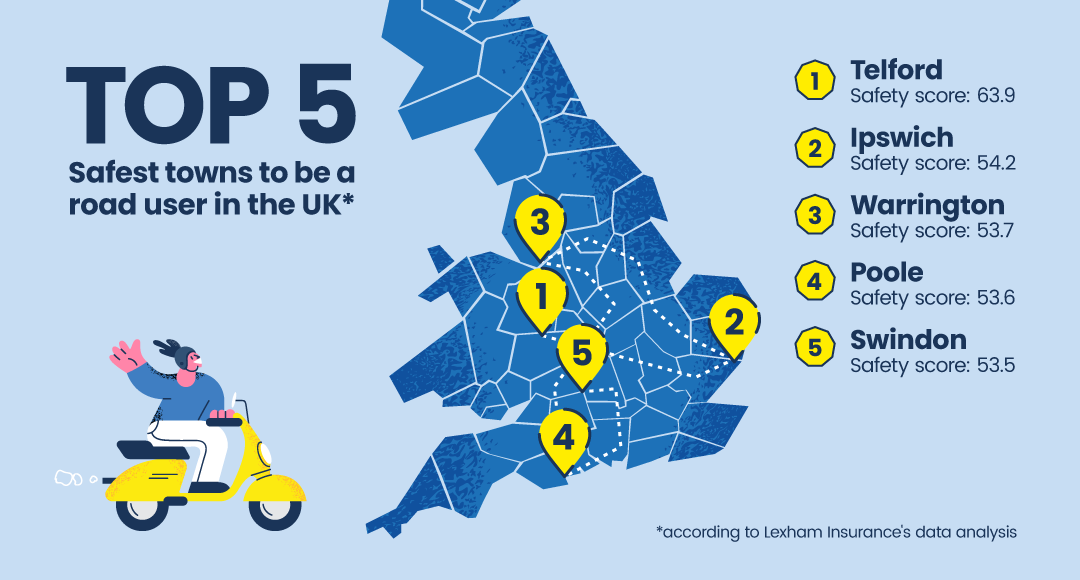
The UK’s safest town is Telford, Shropshire – a relatively new area developed in the 1960s.
Shoreline spot Poole, Dorset, has the lowest crime rate and light pollution.
You’re also least likely to encounter congestion in Middlesbrough, of all the towns AND cities.
| Rank | Location | Safety Score - Out of 100 |
| 1 |
Telford |
63.9 |
| 2 |
Ipswich |
59.4 |
| 3 |
Warrington |
57.4 |
| 4 |
Poole |
56.1 |
| 5 |
Swindon |
51.5 |
| 6 |
Watford |
50 |
| 7 |
Northampton |
49.9 |
| 8 |
Middlesbrough |
49.1 |
| 9 |
Reading |
48.9 |
| 10 |
Luton |
48.5 |
(Rankings based on data collection from Oct 2025)
*Based on our data analysis
TOP 10 SAFETY CONCERNS OF RIDERS
No matter how closely you monitor the weather forecast, two-wheel travel can be marred by hail and gales. Then there are the potholes, which can overwrite an otherwise happy memory of cruising down a country lane. Environmental factors worried the riders we surveyed the most.
Careless behaviour from other road-users, like tailgating – which 39% of those on two-wheels encounter ‘often’ – are the third biggest concern.
Regain control by staying calm, as they’ll have their own reason to rush and/or be emotional – it’s no reflection on you.
| Safety Concern | Percentage of 500+ Riders | |
| 1 |
Bad weather |
51% |
| 2 |
Uneven road surfaces (e.g. potholes) |
51% |
| 3 |
Careless driving or riding by others (e.g. tailgating) |
49% |
| 4 |
Riding at night |
37% |
| 5 |
Poorly lit areas |
36% |
| 6 |
Blinding headlights |
35% |
| 7 |
Road rage (e.g. offensive gestures) |
33% |
| 8 |
Riding through areas with a negative reputation |
27% |
| 9 |
Congested areas |
27% |
| 10 |
Leaving my vehicle (in case it gets stolen) |
24% |
Women’s International Motorcycle Association (WIMA)’s membership secretary, Julie Emmitt, told us:
“Riders face unique vulnerabilities. We’re small and easily missed – you might relate to ‘SMIDSY’ (‘Sorry Mate I Didn’t See You’), especially at dawn and dusk. Built-up areas bring additional concerns like theft risk and, in congestion, especially, road rage from others – I feel this far more acutely on my bike than in the car. But, like me, you might feel the pros hugely outweigh the cons.”

Over to our resident riding expert, Alisdair Wilson, for precautionary steps you can take…
6 TIPS FOR SAFER RIDING
- “Buy a dash cam – Capturing clear, first-hand, and unbiased video footage proves liability (if needed)
- Know your rights – Brushing up on the rules of the road keeps you safe and compliant. Our comprehensive UK bike law guide breaks down regulations (and how these differ by UK city)
- Invest in proper gear – Riders just don’t have the protective outer shell of a car. Our motorcycle helmet guide is a helpful starting point
- Consider your non-negotiables – E.g. riding in a group (whether that’s with friends, or communities like WIMA or that you find on Facebook) or in daylight only
- Master defensive driving – Deep focus and anticipating hazards are key. Our survival tips for new riders should prove handy if you’ve just earned your P-plates, or as a reminder. It’s all too easy to pick up bad habits
- Learn what to do if things go wrong – Hopefully, the worst-case scenario, like an accident, never happens. But should you end up feeling hurt and disoriented, the last thing you want is the extra emotional turmoil of working what to do. Our crashed motorcycle guide walks you through essential first aid and navigating insurance.”
So why not explore medieval York or take to the vibrant streets of Belfast on your next adventure? Strong safety conditions meet standout scenery for an even better riding experience.
METHODOLOGY
Our Rider Safety Index ranks 50 of the UK’s largest towns and cities (by population) based on markers of safety.
The index combines four factors: crime data (double weighted), street lighting levels, traffic congestion, and police station density. Crime rates were sourced from published police data, lighting levels from NASA's Black Marble dataset, congestion from simulated Google Routes journeys, and police stations via Google Places API.
A survey of 1017 road-users (including 518 motorbike / moped / scooter riders) was conducted by Obsurvant in November 2025. All findings are based on 2025 data.