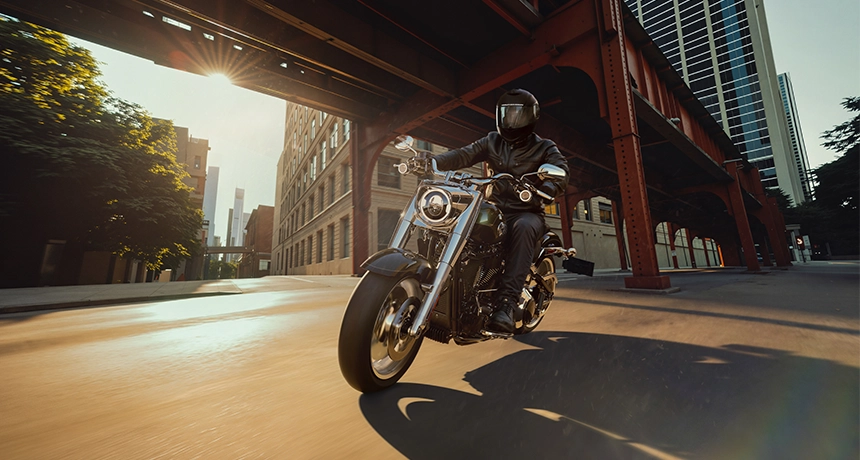
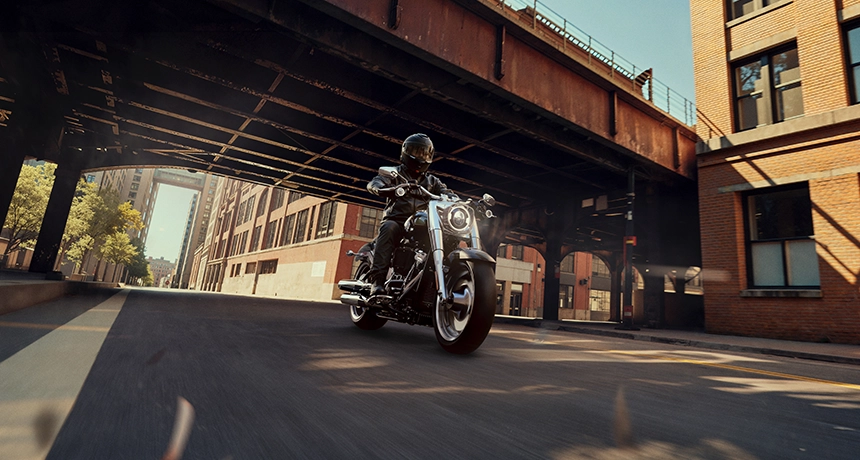
The Fat Boy should need no introduction. Among iconic US brand Harley’s best known and longest-lived models, it was introduced in 1990 as the pet project of Harley Design Chief Willie G. Davidson, was conceived as a more visually striking, retro-inspired, solid-wheeled, fat-tyred cruiser based on the Heritage Softail and became an instant hit, its fame fuelled by being Arnold Schwarzenegger’s ride in hit 1991 movie Terminator 2: Judgement Day.
That popularity has ensured the Fat Boy lives on to this day although it has been successively updated, modernized and improved and is also now more extreme than ever. The biggest, most recent makeover came in 2018 when it gained Harley’s new twin shock Softail chassis along with even fatter wheels and tyres. It also now has riding modes, traction and cruise control and more exquisite style than ever.
We took a half day ride on the latest example on Harley UK’s press fleet, in and around rural Gloucestershire, to see how it measures up today…
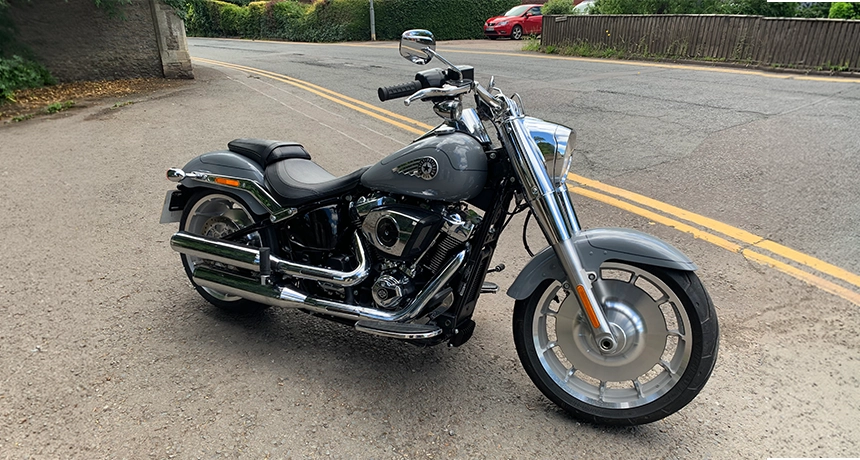
2026 Harley-Davidson FLFB Fat Boy | What is it?
The name says it all. The original 1990 Fat Boy stood out mostly for its chunky, solid disc wheels on an otherwise fairly standard but pared back Softail (hidden shock, for the classic ‘hardtail’ look) chassis.
The result was visually stunning, but it became even more so in 2018 when fully updated with new, even bigger and fatter wheels and tyres – the 160-section front hoop is broader than many bikes’ REAR tyre, while the 240 at the back is simply bonkers.
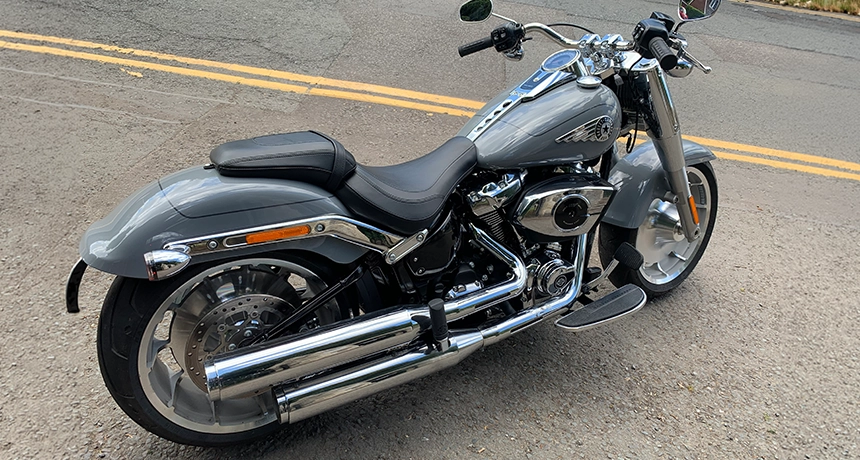
Nor does it end there. You also get a classic ‘50s style cruiser stance complete with upright wide-barred riding position, footboards and fork shrouds and heavily valanced ‘fenders’, all of which makes the Fat Boy look simply fantastic.
While, finally, modern (ish) dynamics come by way of Harley’s latest ‘Milwaukee Eight’ 117 cubic inch (1923cc) V-twin engine, up to date brakes and suspension (the latter by Japanese brand Showa) and even a full suite of electronics including riding modes, cornering ABS and traction control…
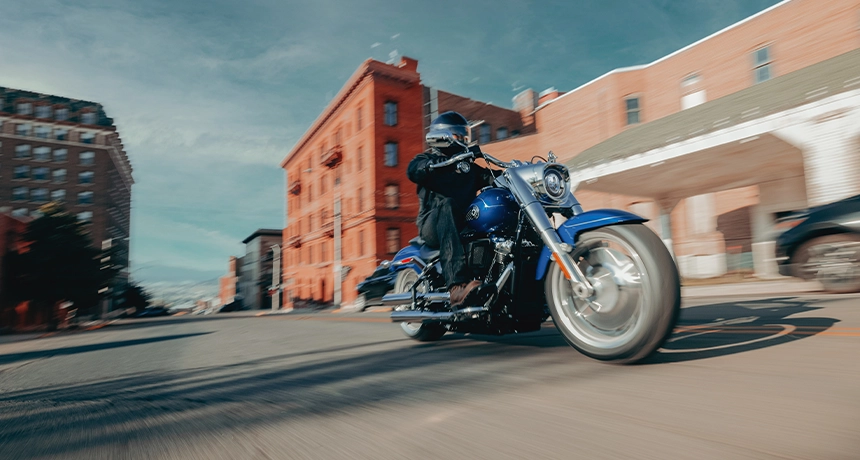
Price and Availability – Harley-Davidson FLFB Fat Boy
Harley-Davidson FLFB Fat Boy | £23,495
The latest Fat Boy starts at a slightly eye-watering price of £23,495 which, when you consider its minimal equipment and that other Harleys such as the entry-level Street Bob can be nearly £10K less, might be a little hard to swallow.
Don’t forget, however, that it’s also beautifully made, iconic, Harley residuals are very good, the Fat Boy is also unique and it’s universally admired – and what sort of price can you put on that?
Like like all current Harleys, it’s available now from H-D’s current network of 15 dealers spread across the UK and comes with the Milwaukee firm’s standard manufacturer-backed warranty lasting 24 months with unlimited mileage covering all parts and labour.
Regarding servicing, the Fat Boy requires its first ‘break-in’ service at 1000 miles with regular check thereafter every year or at 5000 miles, whichever comes first.
For full info, go to the Harley-Davidson UK website.
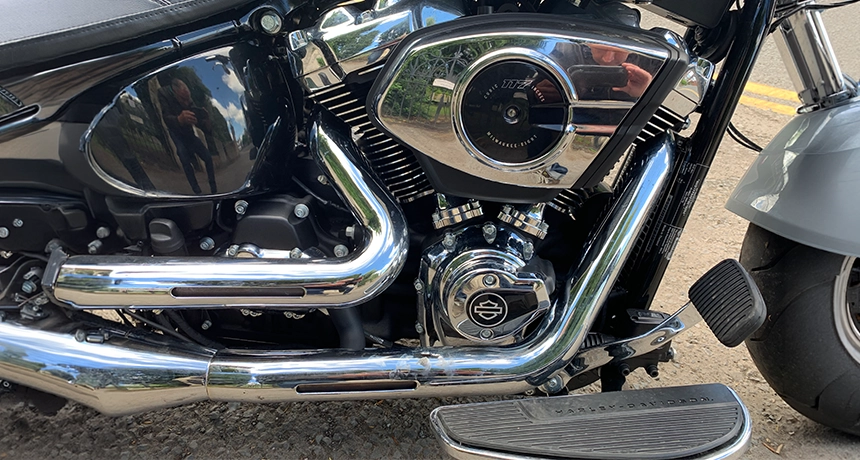
Engine | Definitive V-twin
Air-cooled 1923cc V-twin | 103 bhp | 171 Nm | 4T 4V OHV | 3 modes
At the Fat Boy’s heart is the latest generation version of Harley’s classic ‘Big Twin’ air-cooled, pushrod V-twin, now called the ‘Milwaukee-Eight’, with four valves per cylinder, fuel-injection and three riding modes: Road, Rain and Sport.
Specifically, the Fat Boy gets the 117 cubic inch ‘Custom’ version, meaning it displaces 1923cc, has a custom air filter and as a result produces peaks of 103hp (77kw) at 4800rpm and 126ftlb (171nm) at 3000rpm all through a clunky six-speed box and signature Harley belt final drive.
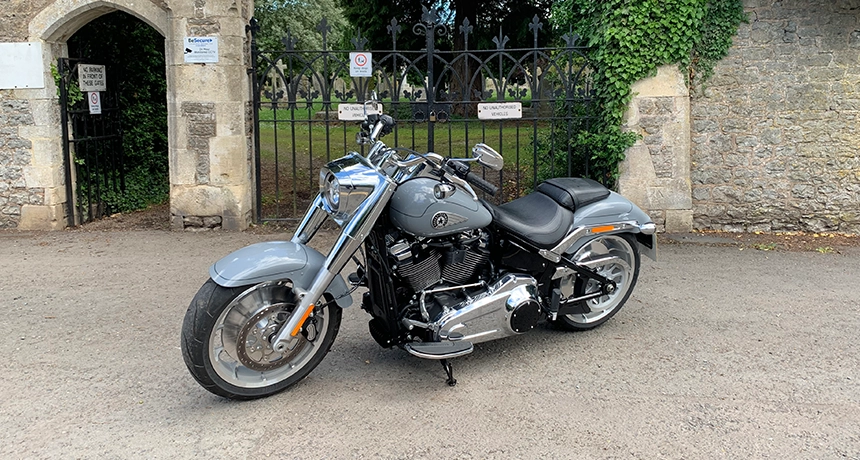
Climbing on board for the first time, however, at Harley’s Gloucester storage facility, is not as extreme as you might expect.
For a big, heavy bike with bonkers wheels, you might expect the Fat Boy to have the intimidating riding position to match – but it hasn’t. Although long (its wheelbase is a whopping 1650mm), and heavy (315kg without fuel), the Fat Boy is also relatively low (the seat’s just 675mm), surprisingly narrow (it’s a V-twin) and stable, while the retro-style riding position also has you upright on a plush seat with feet easily finding broad footboards with ‘beach’ bars, which, although wide, are also low and comfortable.
Engine delivery isn’t intimating, either. If you’ve ever ridden a big twin Harley the Fat Boy’s drive is entirely familiar, predictable, pleasant and sufficient, providing pulsating, characterful and entertaining ‘go’ when you’re in the mood, or just amiable cruising when you’re not. Road mode suits it best – the handling’s not sufficiently dynamic to warrant the edgier Sport mode and, mostly, it delivers how you want and expect – but little more. Fuel consumption, meanwhile, is an entirely acceptable claimed 47mpg.
Handling | Just like Arnie
315 kg | 675mm seat | 1,650mm wheelbase | 125mm ground clearance | Showa telescopic forks & preload adjustable monoshock rear
In 2018, Harley’s whole Softail family was updated with a new chassis, Fat Boy included. That meant a new tubular steel cradle frame with box-section spine and rear subframe.
The characteristic ‘hidden’ twin shock rear end was updated to a new, still hidden, monoshock, which now has a handy, remote preload adjuster. While the forks are now Showa’s 49mm ‘Dual Bending Valve’ telescopics, which are non-adjustable and, in the Fat Boy’s case, feature retro-style ‘beer can’ metal shrouds.
So far, so typically Harley. But what sets the Fat Boy apart is its signature monster wheels. Called the Lakester, they’re both 18inch diameter, solid, cast and machined aluminium with the front wearing a massive 160-section tyre and the rear an even larger 240 version.
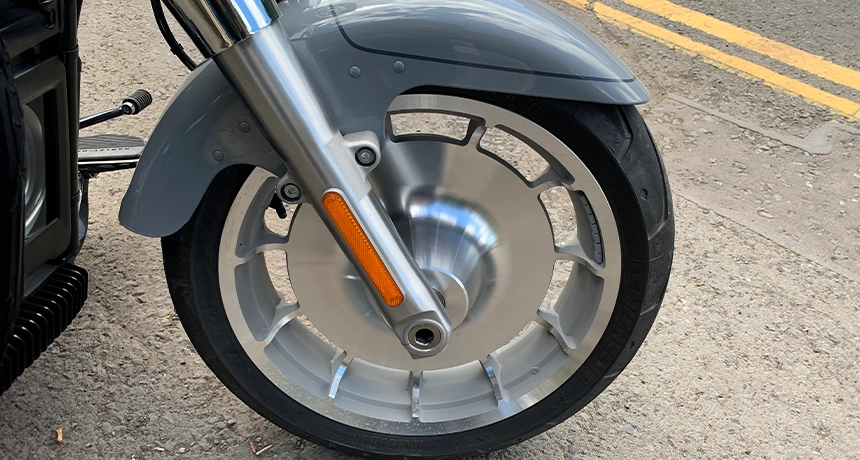
The result, with fairly lazy, slow steering geometry of 30-degrees rake and 104mm trail, takes some getting used to. Steering is slow and has to be deliberate (even with the extra leverage provided by its wide ‘beach’ handlebars); the ride, though largely OK, is upset by potholes due to the short suspension travel, and switchbacks have to be approached with caution and confidence. It’s not terrible. You do tune in and do learn to take it easy and roll the Fat Boy through turns. But it is an unsettling experience at first and if your pleasure from biking is dynamic handling more than mere posing, there are far better handling bikes even in Harley’s own range.
Braking is also a little compromised by the Fat Boy’s style. The desire for ‘clean’ looks means this big, heavy bike has only a single 300mm front disc grasped by a four-piston caliper, and, although mostly enough, especially when used in combination with the 292mm, two-piston rear set-up, it would really benefit from an extra front disc although (even though I’d be loathe to compromise its looks for one). Cornering ABS is standard.
Features | Harley-Davidson FLFB Fat Boy
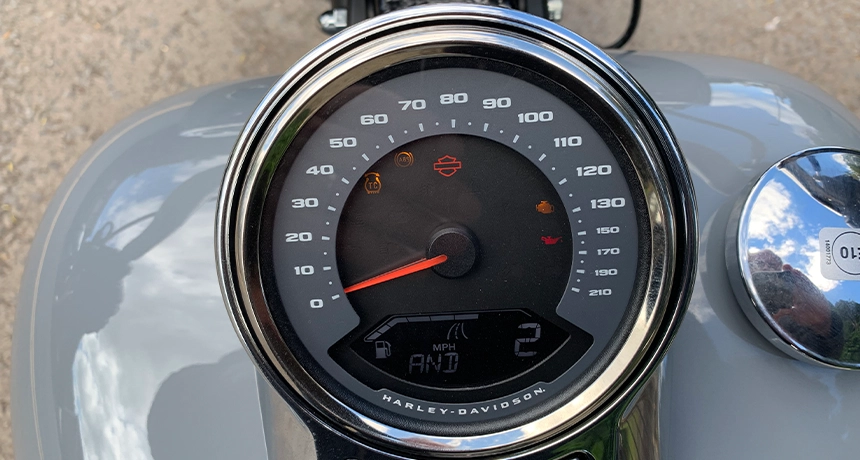
Dash: 5” analogue dial | three modes | 18.9L tank | cruise control
Considering the Fat Boy was conceived as a retro, bare bones cruiser, you shouldn’t really expect much in terms of equipment, irrespective of its hefty price, and, overall, it is fairly basic. But it also has everything it needs and there are lots of quality touches.
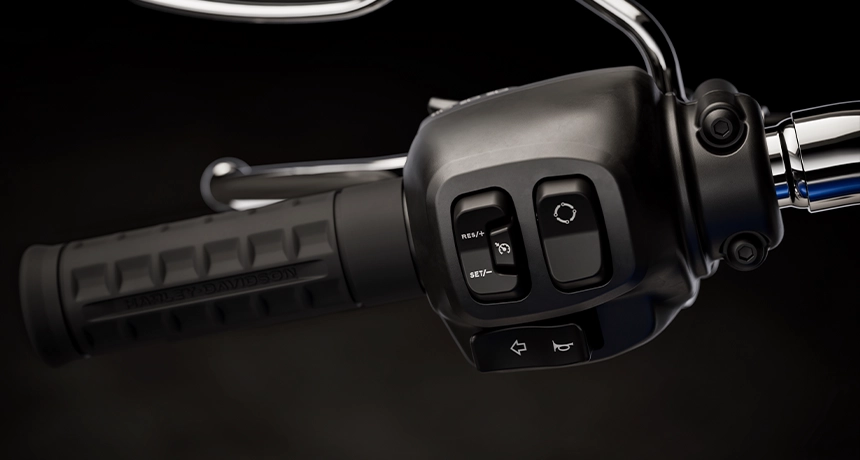
Instrumentation is by a tank-mounted (and thus slightly annoyingly out of eyeline) five-inch analogue dial which includes warning lights; there are three riding modes, cornering ABS and traction, cruise control, a Tyre Pressure Monitoring System (TPMS) and LED lights all round.
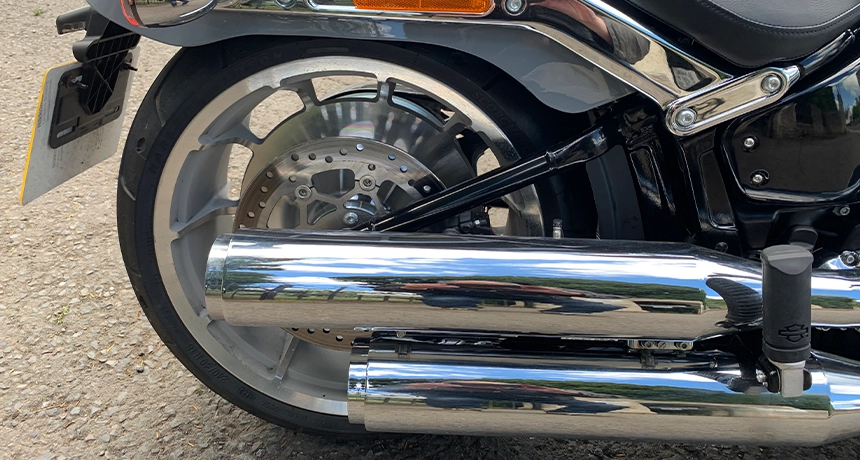
There is also those unique, chunky wheels, shrouded forks, signature Harley ‘shotgun’ pipes, plus it’s all beautifully built and looks fabulous.
Anything else?
It also must be stated here that few bikes are as timeless as a Harley Fat Boy, it’s also unique and universally admired (expect a crowd to gather wherever you go), and Harley residuals are very good, too.
Oh, and if you DO want more, Harley-Davidson is probably head and shoulders above all other manufacturers when it comes to accessories and customising. So, if you did want to add a screen, maybe more pillion comfort or even luggage, you can easily do that, too (admittedly at extra cost).
Pros
-
A huge pose - literally
-
Classy Harley retro style
-
Better dynamics than you may expect
Cons
-
Style before substance
-
Big price to match
-
Other Harleys offer more practicality and value
Verdict | Harley-Davidson FLFB Fat Boy
The Fat Boy is not a motorcycle for wallflowers. Instead, it is all about making a visual statement – and it does exactly that. Within a mile of setting off from Gloucester I’d convinced myself I was Arnold Schwarzenegger, every car driver took a second glance, I felt like I was a king and each time I parked I couldn’t stop looking at it.
But the Fat Boy is also ponderous, awkward, expensive and impractical – so you need to know what you’re getting yourself into. If the plus points appeal and you can live with the realities, you won’t be disappointed – I had a blast riding it around the Forest of Dean for a few hours. But I was also enormously happy that afterwards I was riding something more practical for my 100mile return up the M5 and 6. Even so, as a ‘feel good’ bike that delivers a bigger pose than possibly anything else, they don’t come much better – or bigger – than the Fat Boy.
Thanks to Harley-Davidson UK for the loan of the press bike. Check full specs and information at www.harley-davidson.com
By Phil West
Pictures by Phil West/Harley-Davidson