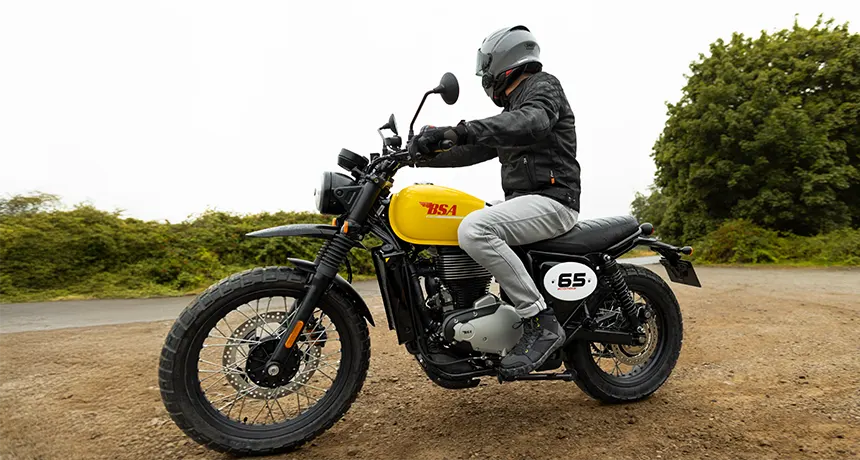
We reported last month on revived historic British marque BSA’s new 350 Bantam, which is an affordable runabout that rekindles the name of the classic 125 and 175cc two-stroke Bantams many motorcyclists grew up on in the 1950s, ‘60s and ‘70s but this time does so with a four-stroke single-cylinder engine.
To do so we travelled to the now Indian-owned firm’s UK head office in Coventry and rode its Bantam demonstrator on a trip down memory lane to the site of BSA’s historic factory in Small Heath, Birmingham.
But we also mentioned at that time that there’s a third new BSA for 2025 – the 650 Scrambler – so at the same time took the opportunity to also try out that in and around Birmingham, again visiting some historic British motorcycling landmarks along the way.
These are our impressions of the new 650 on that journey – with thanks to BSA UK for the loan of the bike.
2025 BSA 650 Scrambler | What is it?
To explain fully what the new BSA 650 Scrambler is we have to do a bit of a history lesson.
BSA, certainly to those of a certain age, is one of the ‘Big Three’ revived British motorcycle marques, alongside only Triumph (which originally went into liquidation in 1983 before being bought and housing magnate John Bloor in 1992) and Norton, which closed its doors in 1977 and has undergone repeated attempted revivals ever since, most significantly from 2020 when it was bought out of administration by Indian automotive giant TVS for a reported £16million and has since been relaunched as a major concern.
BSA’s story is similar to both but much more recent. After being the world’s largest motorcycle manufacturer in 1952 famous for machines such as not only the Bantam but also Gold Star and Rocket3, gradual decline led to the closure of its Armoury Road, Small Heath, Birmingham factory in 1973. Fitful attempts at its relaunch followed but it’s effectively been dormant this century until the rights to the name were bought by another Indian automotive giant, Mahindra, for a reported £3.4million in 2016.
The first all-new Indian-built bike, the retro inspired Gold Star 650 single, was launched in 2022 to rave reviews then, at last year’s Motorcycle Live show at the NEC in Birmingham, the first follow-up model, a scrambler styled retro based on the Gold Star’s powertrain, was unveiled to equally favourable impressions. The Bantam was then unveiled in July.
BSA Scrambler 650 | Price and Availability: £5,999
Despite being unveiled almost a year ago, the new 650 Scrambler didn’t go on sale until mid-summer 2025 for a price of £5999. That compares very favourably to the Gold Star 650’s £6399 (although it’s sometimes been available at a discount) and even more so to its most obvious rivals, the also Indian-built but twin cylinder Royal Enfield Bear 650, which costs from £6749, and Triumph’s equally twin-cylinder (but arguably more high-specced and better quality Scrambler 900, which is currently £9795.
Perhaps as a result, BSA UK tells me that the 650 Scrambler has also proved an immediate sales hit, with over 500 sales recorded.
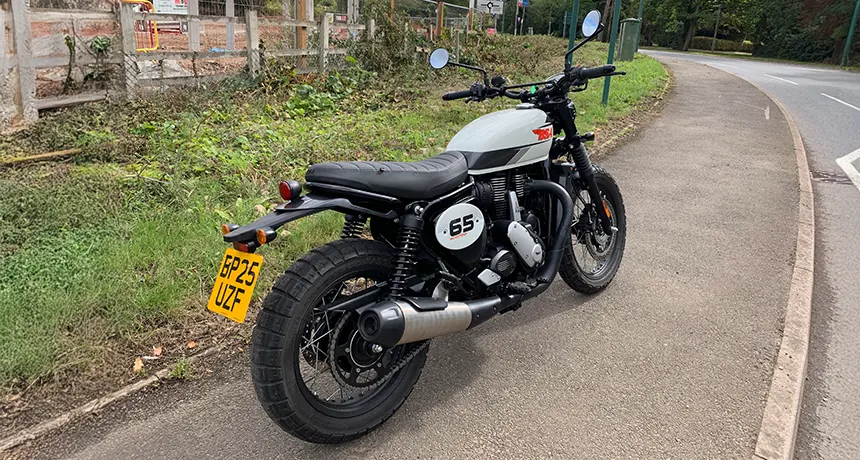
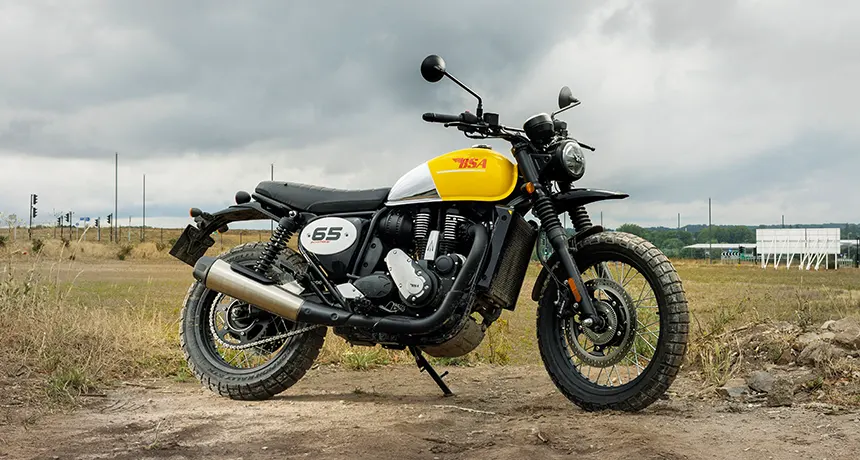
It’s available now in three different colourschemes – the white/black version we tested, a saucy retro yellow/chrome version, or in all-black – from BSA’s growing network of UK dealers, with around 40 currently listed.
It also comes with a standard three-year warranty covering all parts and labour from first registration while recommended service intervals are every 3500 miles, which, admittedly, isn’t that great but considering the type of bike it is and likely mileages owners might cover, is probably tolerable.
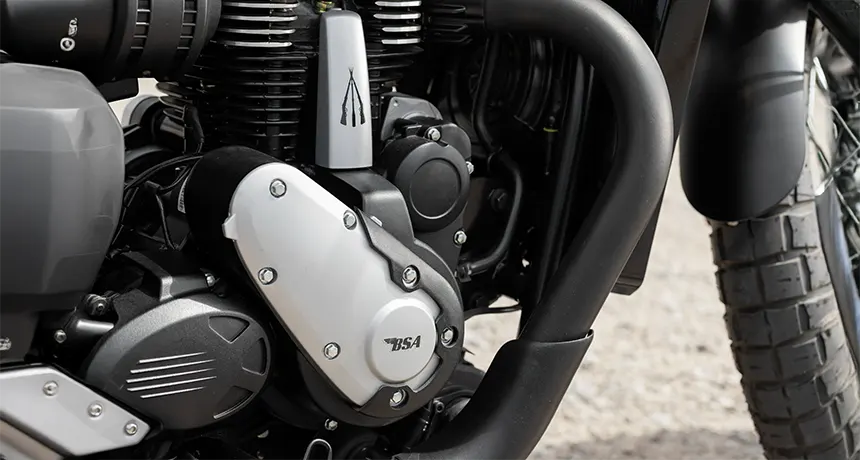
Engine | Familiar single
Liquid-cooled single cylinder | 45 bhp | 55 Nm | 4T 4V DOHC | no modes
As the 650 Scrambler is very much based on the preceding Gold Star 650 retro roadster it’ll come as no surprise that the new bike’s engine is essentially the same in being a liquid-cooled (although it’s styled to look like an air-cooled unit with cylinder fins and discrete radiator), double-overhead cam, four-valve single displacing 652cc. It also has a five-speed gearbox
The Scrambler does have a different exhaust, however from the Gold Star’s ‘peashooter’, although that’s not enough to make a notable difference to its claimed performance which remains as a peak power of an A2-compliant 45bhp at 6500 rpm and peak torque of 55Nm at a lower 4000rpm.
But if that sounds a little underwhelming, for its intended use it’s not. One of the highlights of the donor Gold Star was how capable and characterful its single-cylinder engine was in comparison to its rivals. It gives nothing away to Enfield’s 650 twin, for example, yet is more stirring and still smooth enough. While simply by being a single makes the BSA far more suited, in my mind anyway, to this ‘scrambler’, off-road-influenced use.
No, there are no riding modes but, truthfully, as a 45bhp retro you don’t miss them, with, instead the only electronic riding aids being a fairly rudimentary traction control and ABS system.
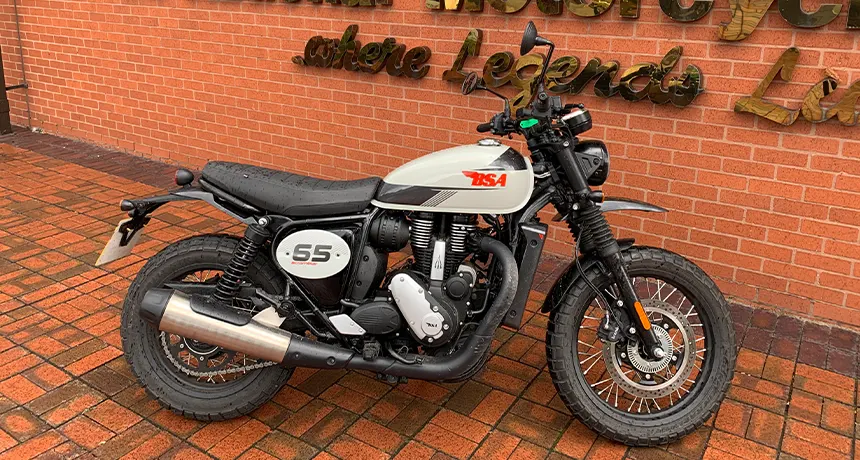
As with the 350 Bantam, our test ride started at BSA’s UK distributor, Lukas Distribution on the outskirts of Coventry by Coventry airport, with a similar, simple plan of following the A45 west towards Birmingham, heading towards the site of BSA’s historic factory in Armoury Road, Small Heath (which I’m warned by modern BSA is now so run down I wouldn’t want to linger there for long).
On the way I’d pop in the National Motorcycle Museum near the NEC, then sweep by Triumph’s historic home in Meriden which, also sadly, is no longer there and instead is represented only by a memorial plaque and an aptly named housing estate, all familiar ground from the Bantam test.
But, having ridden its sister Gold Star on many occasions, if I’d been expecting the Scrambler to be instantly familiar, too, I was mistaken. Although BSA’s newcomer looks easy and predictable it’s actually not – not quite anyway. Instead, climbing on board for the first time, it felt slightly odd, as if the bars aren’t positioned quite right and with a seat that’s angled slightly funny.
In truth it’s not a problem and the rest of it – middling proportions, slim, light weight, basic controls, upright riding position and easy, flexible drive – is so unintimidating that I quickly forget the initially heavy-feeling steering, happily cruise at a regulated 40-50mph down the A45, and those initial quirks are quickly forgotten.

Handling | Stereotypical scrambler
218 kg | 820mm seat | 1,463mm wheelbase | N/A ground clearance | telescopic forks & twin shock rear
I cock-up the entry into the NMM so find myself traversing around the NEC but it serves to remind me what an easy – yet stylish and eye grabbing – bike this is.
The engine’s so flexible, the gearshift so slick and the steering, even on semi-knobbly Pirellis on damp roads, is so neutral, light and precise that urban ‘bimbling’ is an easy joy, allowing me to instead revel in the BSA’s rorty soundtrack and snatch occasional pleasing reflections in shop windows.
After a quick photostop outside the NMM (no time to venture inside today) I next turn off the A45 into the village of Meriden and again pause for a documenting pic. The Scrambler’s so light and manoeuvrable parking on the pavement holds no concerns.
Then, with Meriden memorial found (the factory site was flattened by new owner John Bloor after purchasing the remains of Triumph in 1983 with a housing estate including Bonneville Close and Daytona Drive built on the site), I ride the BSA along the grass verge with no qualms (it is an off-roader after all), for a picture alongside.
Yes, these are innocent, undemanding pursuits, but they are also pleasant and appropriate and something I’d far less easily attempt on, say, a big litre-class adventure bike and so give a flavour of how easy and unintimidating the BSA is.
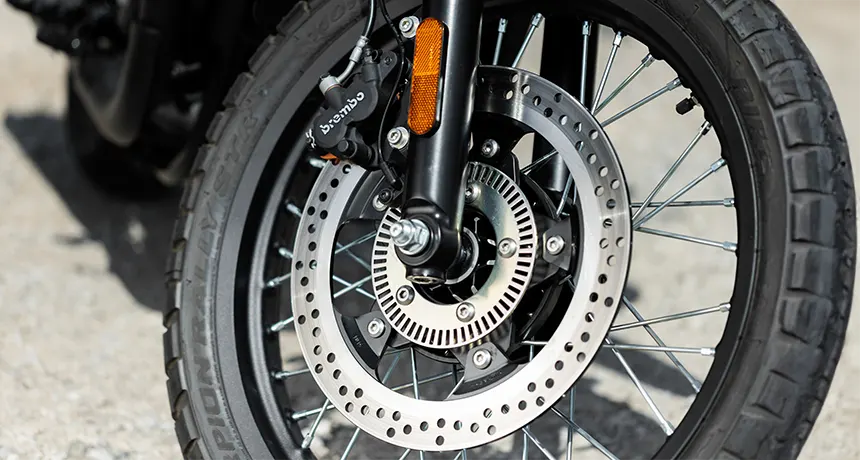
Next, I’m back on the A45 headed into Birmingham’s urban gridlock – and again the BSA is a delight – notably perkier and more substantial than the slightly diminutive, more basic and less evocative 350 Bantam I’d ridden earlier and also more stylish and eye-grabbing – so much so I’m starting to develop a real fondness for it.
The dual carriageway also gives me brief moments to suss out the Scrambler a bit more. Its round, 5in TFT is at once in-keeping with the retro scrambler style and sufficiently modern to be crammed with all the info’ you need. The stylised bar grips are a nice touch.
The mirrors work fine but look a bit budget and the switchgear, although having a bit of a budget feel too (and, oddly, a few redundant buttons on the left pod, too, hinting at something of a ‘parts bin’ approach) is also up to the job – if no more.
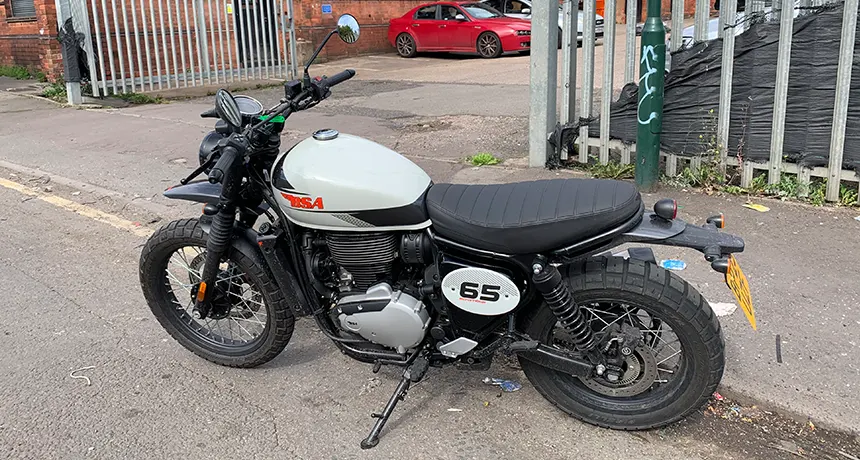
But there are more than enough sweet details to more than compensate: The chromed filler cap has embossed BSA logos; the ‘Victor Yellow’ paint option (which is sadly not the one I’m riding today but is the one I would choose), with its yellow and chrome tank, sweetly mimics BSA scramblers of yore; the rubber fork gaiters are a nice touch and the seat also has embroidered BSA logos and a mini, sewn-in union flag.
As with the even more budget Bantam, ultimately there’s nothing here that’s quite as posh, premium or quality as there is, say, on Triumph’s (admittedly £3000 more expensive) Scrambler, but nor, as a basic retro, is it really missed. I could happily live without it and would look forward to instead spending some of the money saved on a few choice cosmetic accessories, instead.
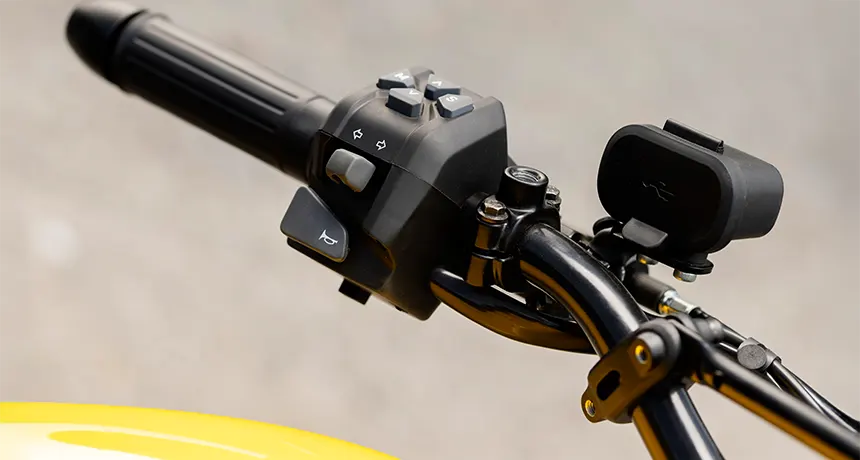
Features | BSA 650 Scrambler
Dash: 3” TFT dash | no modes | 12 L tank | Traction Control | ABS
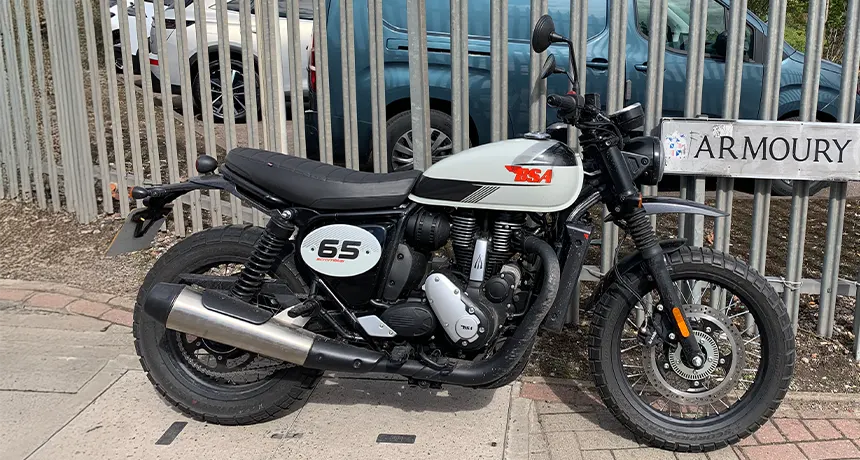
But as I turn down historic Armoury Road and ride to the end to see the sorry remains of the old, massive BSA Factory (just one section of the original, pioneeringly concrete plant remains, now occupied by shady businesses and strewn with litter and parked cars) I also feel a sense of occasion that’s priceless and completely undeserved by the modern surroundings.
This is what riding a retro should be all about – taking you to a place mechanically and emotionally – and the new BSA 650 Scrambler simply does it in spades. I part the bike up as near to any vestige of the old works as I can find: the Armoury Road Street sign and, at the opposite end, a wall-painted ‘BSA’ (which actually refers to the surviving armaments business, not the bike one, is the best I can do.
But it’s still significant, moving even. Even more importantly, the 650 Scrambler is a worthy focus of the photo. I’m yearning for a passer-by to stop and ask, ‘Is that a REAL BSA?’ but no-one does. That, too, is part of the fallacy of the retro motorcycle dream.
Back to the future…
But photos taken, sad reflections on what has become of BSA done and a date back at modern BSA UK, I head back on the A45 towards Coventry with a broad smile on my face.
Now fully attuned, the 650 Scrambler really is a sweet little bike that’ll easily, affordably give any owner a similar journey – and that’s surely what it’s all about.
Pros
-
Authentic style and brand
-
Credible spec and dynamics
-
Class-leading value
Cons
-
Slightly 'budget' in some areas
-
Unproven reliability/durability
-
Limited practicality/versatility
Verdict | BSA 650 Scrambler
No, the new BSA 650 Scrambler is not particularly sophisticated, dynamic or potent but none of that really matters. What it is, is a really nice-looking scrambler with BSA on its tank, Brembo and Pirelli among its cycle parts, has enough chirpy performance to enjoy in the real world yet is sufficiently simple and unintimidating to ride immediately.
But best of all, it’s a modern BSA motorcycle that’s also brilliant value. As mentioned earlier, at £5999, it’s not only good value, it undercuts its only truly credible competitors, Royal Enfield’s new 650 Bear and Triumph’s Scrambler 900, with the former also not as authentic, evocative or good looking and the latter, although excellent, so much more (at £9000+) and also still not made in Britain that it’s a completely different animal.
I liked BSA’s first revival bikes, the Gold Star, for its value, characterful engine and for being, well, different than the established retro twins. But to be honest, as a child of the ‘70s, its ‘50s styling did little for me.
The Scrambler, though, has not only exactly the same engine and dynamics, but is better looking, being scrambler style is a little larger and taller (so better suits 6’3” me), being ‘70s style is right down my street and, at £5999, is even cheaper – so much so that it’s the first middleweight retro I’m seriously considering buying. Maybe you should, too.
Thanks to Lukas Distribution for letting us have a test ride, check the full specs and information at https://www.bsacompany.co.uk
Pictures by BSA/Phil West