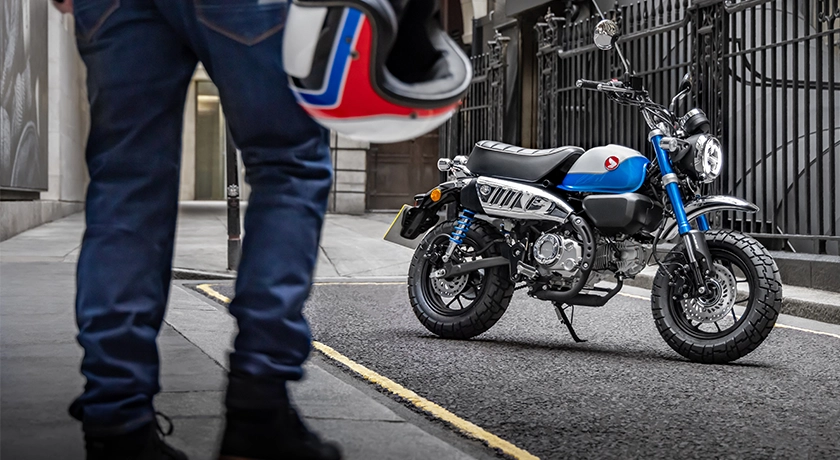
With Honda recently announcing new colours for the latest version of its iconic Monkey bike, there’s never been a better time to tell the whole story of the Japanese giant’s diminutive wonder, which is known for its tiny wheels, cute style and urban fun experience – and it’s one that dates back over 70 years.
While the current incarnation is a road legal 125 suitable for A1 class learners and more, the original, created way back in 1961, was intended as little more than a short-lived amusement park ride.
In February of that year, Motorsports Land Corporation was established as a wholly owned subsidiary of Honda to handle major projects such as preparing for the opening of Honda’s Tama Tech (Tokyo) and Ikoma Tech (Nara) motor vehicle amusement parks along with the construction of the Suzuka racing circuit, all conceived to establish and foster a healthy motorsports culture in Japan.
Where it Began | 1961 Monkey Z100
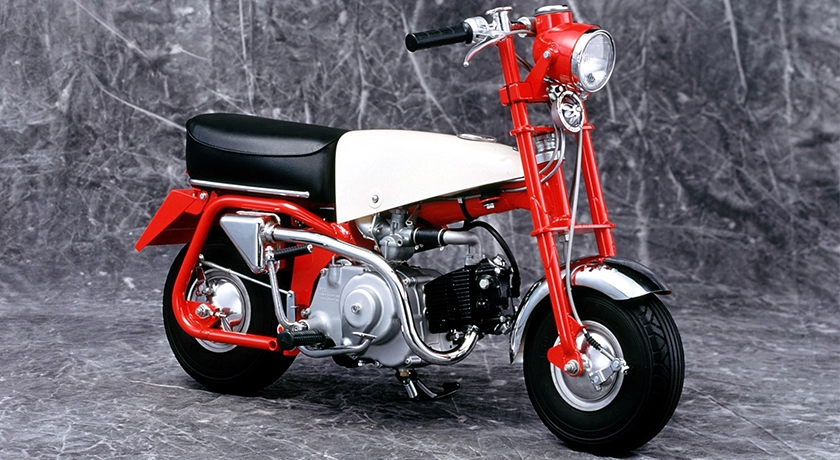
The Z100 minibike was conceived as a ride for these parks able for kids to ride so had ultra-compact dimensions, tiny wheels wearing five-inch tyres and was powered by an equally small 50cc engine from Honda’s Super Cub commuter. There were no plans to release it as a production model.
But in 1962, Honda exhibited the now ‘Monkey’ Z100 at the Frankfurt and London shows and, gaining a positive response, shipped 20 Z100 units to Honda Europe that December.
This led to the development of a road-legal, export model. Similar to the Z100, the CZ100 was also powered by the 50cc 4-stroke, OHV single-cylinder Super Cub C100 engine, but to accommodate adults, its frame was redesigned and made more rigid. Its 6-litre fuel tank was borrowed from the Sports Cub C110/C115, and the result went into production in 1964.
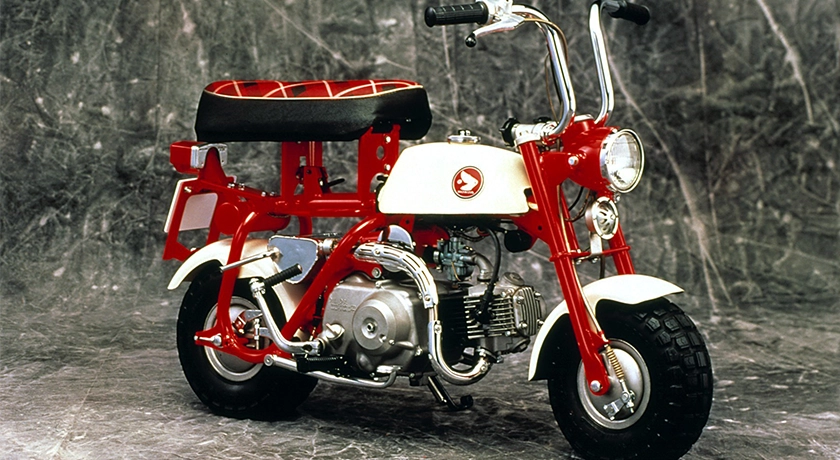
Six Years On | 1967 Monkey Z50M
Again, it was a significant hit. In its three-year production run, around 2,500 were made. Due to this, development of the next model for public road use began.
This time, in addition to the lights and brakes necessary for riding on public roads, the ability to be loaded into a car boot was also an important factor. The result was the 1967 Monkey Z50M.
Despite its small size, the Z50M’s seat and handlebars were designed to be high enough for an adult, but foldable. Its engine was the 4-stroke, OHC, 50cc single made popular by the Super Cub, paired with an automatic centrifugal clutch and a 3-speed transmission for easy operation and enjoyable riding.
Its popularity marked the beginning of the Monkey series becoming a long-selling hit.
Enhanced Performance & Larger Tyres | 1969 Honda Monkey Z50A
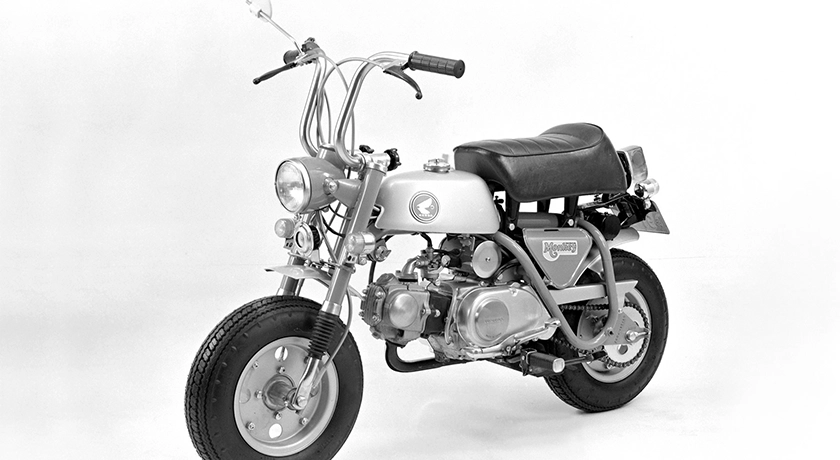
Two years later, the Monkey Z50A was launched with enhanced performance, larger tyres (from 5 to 8 inches) and new front suspension. At the same time, other improvements included a 6V battery, indicators as standard and a thicker seat to improve riding comfort. Brake operation was changed to handlebar levers.
Introduction of the 'Spin Off' Monkey Bike | 1969 Honda Dax
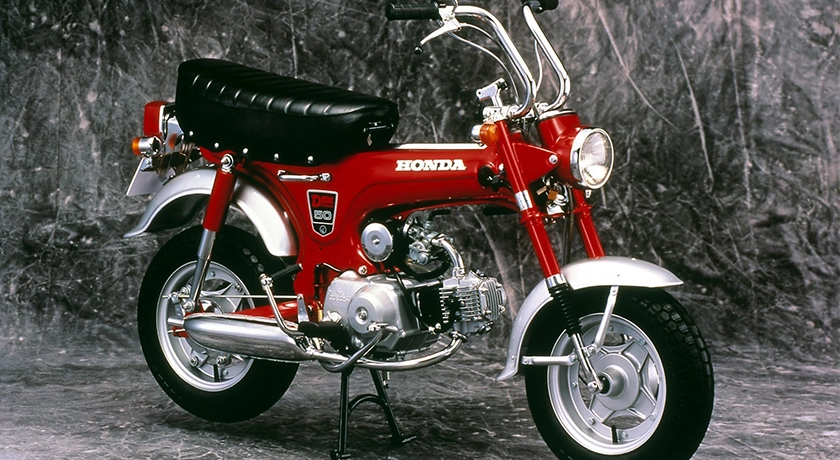
1969 also saw the first Monkey bike spin-off model – the Honda Dax.
Created as a larger, more comfortable alternative to the Monkey and designed for two-up riding with a distinctive pressed-steel ‘T-bone’ frame that also housed the fuel tank, the Dax featured 10-inch wheels, foldable handlebars, and came with either a 50cc or 70cc four-stroke engine with a centrifugal clutch and in 70cc form was known as the Trail 70 in the US.
This, too, was a big hit, spawning a series of developments and remained in production until 1981, with various revivals before the modern revival. The retro-styled ST125 was launched in 2023.
Keeping it Compact | 1970 Honda Monkey Z50Z
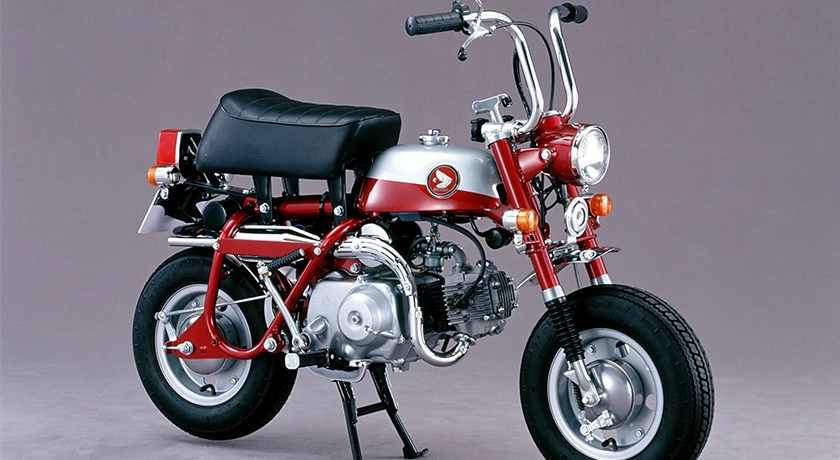
A year later, in 1970, the Monkey Z50Z was launched to replace the Z50A.
The Z50Z was designed to be more compact still, with the front end detachable from the front suspension. A stand was added to secure the bike when the front end was detached, and its braking system reverted to handlebar-lever and foot-pedal operation. The styling was also more aggressive, with an upswept silencer.
All New Styling & Rear Suspension | 1974 Honda Monkey Z50J
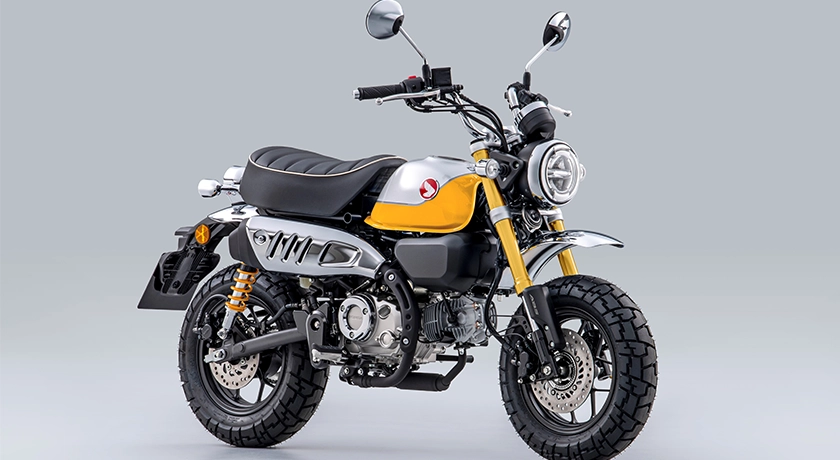
In 1974, four years later, Honda’s Monkey underwent even more major changes.
Not only did the new bike, the Monkey Z50J, have a completely redesigned frame and a ‘series-first’ rear suspension, but it also featured knobbly front and rear tyres for riding on the dirt.
Its fuel tank was also increased from 2.5 to 4 litres, which further added to its appeal as a leisure bike, along with a more comfortable seat and rear carrier.
Welcoming Another Spin-off | 1978 Honda Gorilla
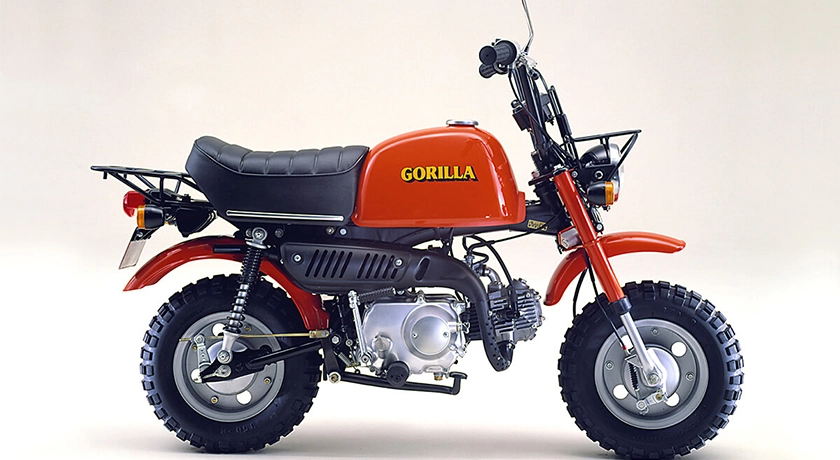
1978 also saw the introduction of a further spin-off model – the Gorilla.
This larger version had essentially the same engine and chassis as the Monkey, but its fuel tank had a larger capacity of 9 litres, a larger seat and other features which made it look larger than the Monkey.
It was also equipped with a front luggage carrier, making it suitable for outdoor touring.
The Model that Stuck Around 'til 08 | 1978 Honda Monkey
In 1978, the Z50J was revamped again.
Although the 1974 Z50J had a significantly enlarged fuel tank, going from 2.5 to 4 litres, the new 1978 Honda Monkey had an even larger 5 litre, teardrop-shaped item.
It also got a larger, more comfortable seat and a 4-gear (instead of 3) automatic centrifugal clutch.
After 1978, the Monkey’s styling remained basically the same, although a few special editions were launched inspired by GP and Dakar racers.
But after 2006, new emissions regulations demanded an all-new machine.
The Final 50cc Monkey | 2009 Honda Monkey
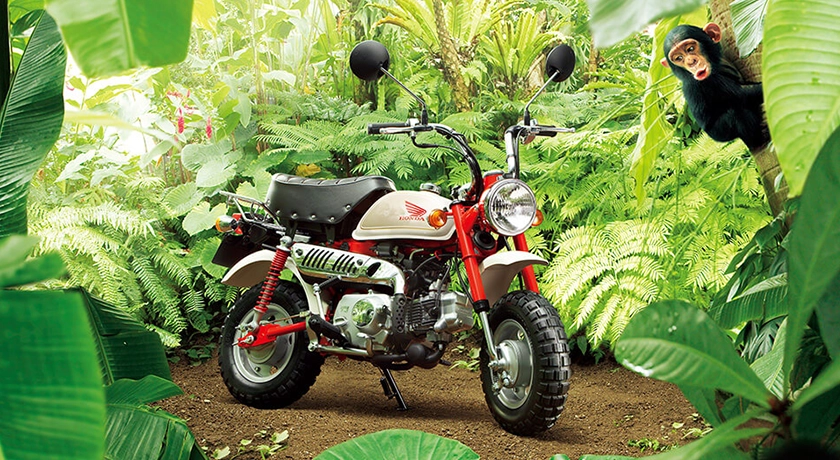
The new Monkey’s engine was the air-cooled, 4-stroke, single-cylinder 50cc OHC engine from the Super Cub 50 released in 2007, complete with electronically controlled fuel injection and a catalyzer in the exhaust pipe to enhance environmental performance.
It was launched in 2009 and survived until 2017 as the last ‘Z-series’ 50cc Monkey.
The New 125cc Monkey | 2018 Honda Monkey
However, in 2018, Honda unveiled a new Monkey 125 as a retro-inspired road-legal A1 class machine based on the mechanics of the popular MSX125 ‘Grom’, which had become something of a cult machine since 2014.
The new Monkey 125 has itself become something of a cult machine, was updated in 2022 with an uprated engine, spawned its own Dax spin-off in 2023, again with a pressed steel frame and twin seat and, with new colours and further tweaks for 2026, the 9bhp, £4199 Monkey looks set to survive for a good few years yet.
The Last Stop!
The Monkey 50 may be no more but long live the Monkey 125!